The 3-Layer Email Security Model for 2026
A layered model against phishing, spoofing and account takeover.

Why it is worth reading
Email is still the most exploited channel in the enterprise - and the most damaging attacks no longer carry malware. Highly targeted phishing, Business Email Compromise, and supplier impersonation abuse trust and context, which is exactly what the built-in controls of platforms like Microsoft 365 were never designed to stop. On top of that, even well-funded programs erode through manual triage, configuration debt, and unclear ownership.
This guide lays out a 3-layer model for 2026: built-in protection as the baseline, standard email security for control, hygiene, and compliance, and advanced AI-driven, context-aware threat prevention on top. It adds a four-level maturity model, five operational levers that decide whether the layers actually work, and the Marquardt customer case as a reality check.
What is inside
- Why email is still the primary attack vectorEmail blends technical systems with human trust - and static rules and signatures no longer match how attackers operate.
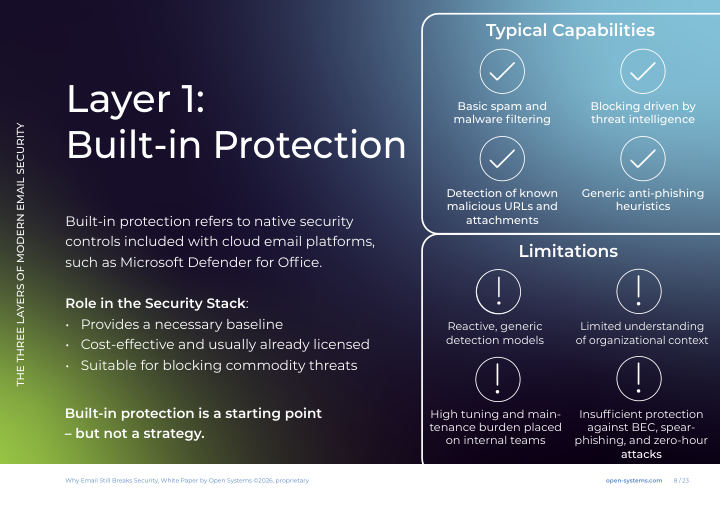
- The three layers of modern email securityBuilt-in protection as baseline, standard security for control and compliance, advanced AI-based detection for the unknown.
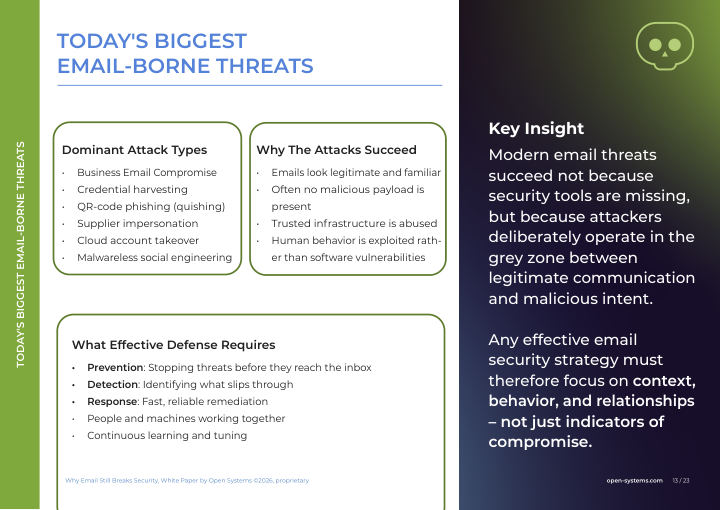
- Today's biggest email-borne threatsBEC, quishing, supplier impersonation, and account takeover - and why they succeed without any malicious payload.
- Operational realityWhy undermanagement, configuration debt, and unclear ownership quietly undo even well-funded email security programs.
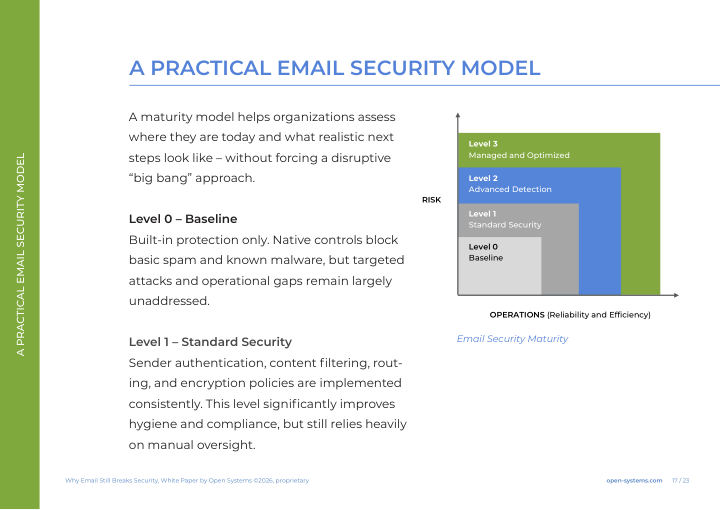
- A practical maturity modelFour levels from baseline to managed and optimized - realistic next steps instead of a disruptive big-bang rollout.
- Customer perspective: MarquardtEmail security treated as business-critical infrastructure - more effective protection with less friction for internal IT.

Built-in protection is a starting point - but not a strategy.Who it is for
- CISOs making the 2026 case for email security investment
- Security architects layering protection on top of Microsoft 365
- IT and SOC teams stuck in manual triage and false positives
Founded in Switzerland. Backed by Swiss Post.
Founded in Switzerland in 1990, Open Systems generates more than USD 100 million in annual revenue and supports global enterprise customers operating in more than 180 countries. Since 2024, the company has been part of Swiss Post, combining Swiss trust and stability with global reach. As a European alternative to US- and Israel-based cybersecurity providers, Open Systems is guided by strong principles around sovereignty requirements, regulatory alignment, transparency and shared responsibility - taking clear ownership for security, performance and operational outcomes, helping organizations maintain control in an increasingly complex digital landscape.
Autonomous SASE. AI-run. Human-backed.
You might also like.

Boost Email Security Efficiency
Where email defenses leak time and ROI, and how to close the gaps.
Read more →
Enabling Qapital
Up to 40% more malicious email intercepted: a FINMA-regulated Swiss asset manager strengthens its top attack vector.
Read the story →
Marquardt
Mechatronics group, 21 locations, 10,000 people: the network run as a service.
Read the story →