Cybersecurity Survey 2025: EU cybersecurity regulations now shape IT strategies, while CIOs call for European providers
Sovereignty moves to the boardroom - 48% of security executives demand EU-based providers, while regulatory pressure reshapes strategy and budgets across the region
Zurich, Switzerland - 25. June 2025 - Cybersecurity decision-making in Europe is undergoing a quiet transformation - driven by rising regulatory pressure and growing demands for digital sovereignty at the executive level. A new report from Open Systems reveals that 48% of CIOs and CISOs now explicitly demand European-based security providers, while 43% of all organizations - and nearly three quarters of C-level executives - say that frameworks like NIS2, DORA and the Cyber Resilience Act directly shape both their security investments and vendor choices.
The study is based on a survey of 371 IT and security decision-makers across Germany, the UK, Austria, and Switzerland.
“The sovereignty debate has left the back office and entered the boardroom,” said Daniel Gerber, Chairman of the Board at Open Systems. “We’re seeing a decisive shift: compliance is no longer a final checkpoint, but a driver of strategy, architecture and supplier shortlists.”
What today’s security leaders say:
- Criteria like sovereignty, regulation alignment and certifications far outweighing lock-in concerns including vendor dependency.
- 48% of CIOs/CISOs demand European-based providers
- 43% of all organizations - and 72% of the C-suite - say EU regulations dictate both strategy and supplier selection
- Hybrid-cloud protection and the cyber-skills drought remain the top execution gaps
Key sector & regional findings:
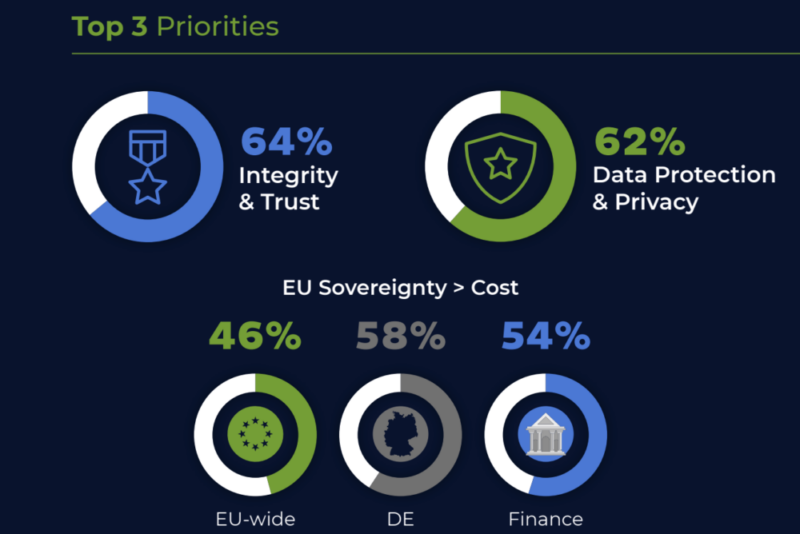
- 46% of European security leaders now rate EU data-sovereignty as their single most important buying criterion - ahead of cost. In Germany, that figure soars to 58%, and among finance CIOs it reaches 54%.
- Finance and healthcare sectors continue to lead the EU trust trend: over half prefer EU-based providers, and nearly half report strong pressure from NIS2 and DORA.
- The least important selection factors when choosing between EU or global cybersecurity providers are: vendor lock-in concerns (23%), flexible pricing/contract models (25%), and best ROI (25%).
- In contrast, provider integrity and trustworthiness (64%) and data protection and privacy (62%) rank as the most important.
- Challenges like connecting remote locations (4%) and lack of flexibility in vendor solutions (8%) are barely mentioned - underscoring that it’s the combination of hybrid work, cloud environments, and skills gaps that creates pressure, rather than isolated technical issues.
“Security leaders are not just responding to regulation - they’re building architectures and teams around it,” said Markus Ehrenmann, CTO of Open Systems. “And they’re demanding platforms that combine EU-hosting, zero-trust control, and out-of-the-box audit readiness.”
New Role of Managed Services
The limited concern around vendor dependency likely reflects a shift of organizations towards regulatory fit and service quality. While only 25% still consider vendor lock-in a relevant factor, 55% now prefer European-based providers, and 70% feel tangible pressure from frameworks like NIS2 and DORA. This underlines a growing demand for partners who not only meet compliance requirements but also support operational execution.
The top IT challenges cited in the study clearly relate to complex technical environments - including hybrid infrastructure, multi-cloud adoption, and skills gaps in network and security operations. This makes it increasingly important that managed services combine consulting expertise with the underlying technology.
Providers must offer:
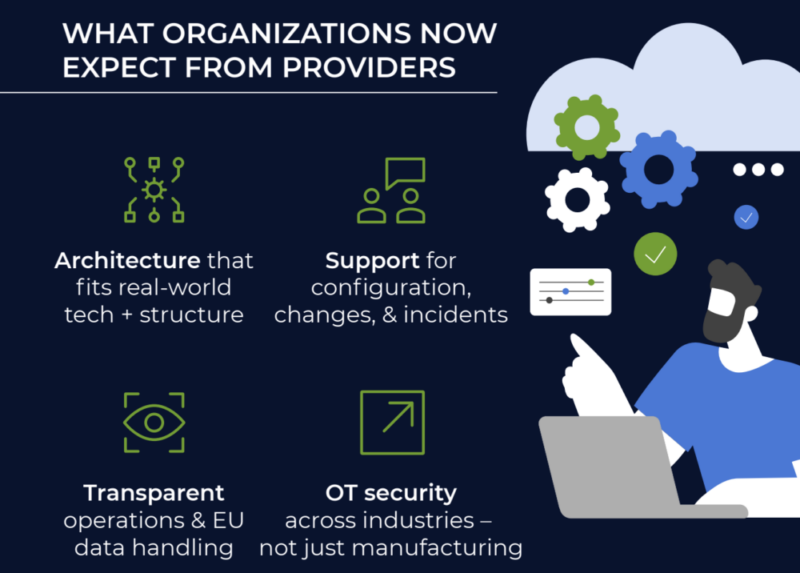
- Effective architecture design that works in practice with the technology deployed and is tailored to each organization’s structure and risk profile.
- Close support during configuration and operations, filling internal gaps and acting as an extension of the team.
Survey respondents also listed the following top three IT projects driven by new regulations:
- Security operations and incident/audit handling (45%)
- Data transparency and processing (e.g. SIEM visibility) (37%)
- IT/OT convergence and OT security (36%)
These trends place new demands on security providers:
- There must be a plan for ongoing operations, particularly for organizations without the capacity to manage incidents, changes, or reviews internally.
- Transparency is critical: how and where security data is processed, whether it remains in the EU, and how it is accessed (e.g. via real-time dashboards, drill-downs, APIs).
- OT security must be addressed beyond manufacturing: 48% of industrial companies, and 44% of finance and healthcare respondents cite this as a pressing need. Providers must go beyond technology (e.g. ZTNA, OT firewalls) to help design secure architectures and realistic transformational planning and successful migration strategies.
About the Survey
The research was conducted in Q2 2025 and includes responses from 371 qualified IT/infrastructure/security leaders, spanning C-level executives, mid-management, and technical roles. Respondents represent a wide spread of industries and company sizes, with balanced representation across the DACH region and the UK.
About Open Systems
Open Systems is an AI-first SASE platform company delivering secure access and networking to help enterprises connect users, applications and infrastructure across complex hybrid and multi-cloud environments. Its proprietary platform combines SSE capabilities, including ZTNA, SWG, CASB and FWaaS, with SD-WAN, end-to-end connectivity, unified policy management, and advanced analytics in a single architecture.
While many cybersecurity providers focus primarily on advancing technology capabilities, Open Systems combines its AI-first SASE platform with an execution model designed for real-world operability, ensuring services are not only deployed, but continuously run, adapted and improved through a combination of AI-enabled operations and NOC-based expertise (Mission Control), built on decades of operational experience, helping organizations reduce complexity, increase visibility and strengthen security outcomes at global scale.
Founded in Switzerland in 1990, Open Systems generates more than USD 100 million in annual revenue and supports global enterprise customers operating in more than 180 countries. Since 2024, the company has been part of Swiss Post, combining Swiss trust and stability with global reach. As a European alternative to US- and Israel-based cybersecurity providers, Open Systems is guided by strong principles around sovereignty requirements, regulatory alignment, transparency and shared responsibility - taking clear ownership for security, performance and operational outcomes, helping organizations maintain control in an increasingly complex digital landscape.
For interviews, briefings, quotes, survey data or images, write to mediarelations@open-systems.com. Media relations sits in Zurich and answers in English or German.
Also on the record.
Open Systems Achieves Swiss Made Software Label, Strengthening Its Commitment to Security, Quality, and Regulatory Trust
Swiss Made Software stands for precision, reliability, and innovative solutions. Discover its impact on the tech industry.
Open Systems Named a Major Player in Two IDC MarketScapes: Worldwide Managed SD-WAN Services and Worldwide Managed Security Service Edge (SSE) Services
Dual recognition affirms Open Systems’ key role as a European-based provider of seamlessly integrated networking and cybersecurity services.
From Switzerland to the World: Open Systems Marks 35 Years of Secure Connectivity
Reflect on 35 years of secure connectivity and understand its importance in building trust in digital interactions.