Audit readiness: how Open Systems takes the pain out of compliance
 Ivan Rivic, CISO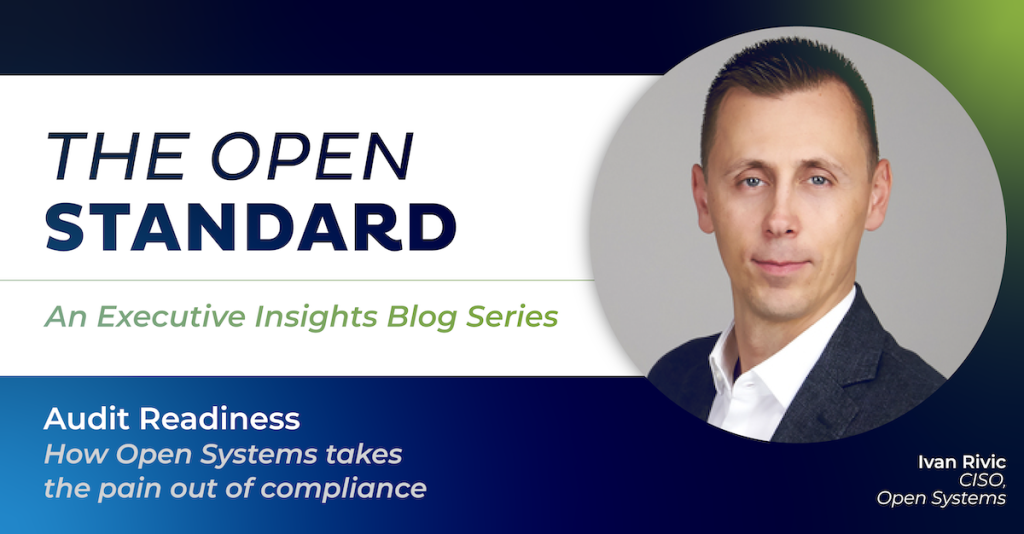
For CISOs, audits have stopped being events in a calendar. They are a constant background condition: DORA. NIS2. ISO 27001. SOC 2. IEC 62443. Plus customer questionnaires. Plus board expectations.
If you are honest with yourself:
- How many tabs do you open when someone writes “the auditor needs proof”?
- How long does it take until you have one clean chain from “policy” to “log”?
- And how much of that knowledge depends on two people who “know where everything is”?
If the answer is “too many tabs, too many days, too few people”, keep reading.
This is what changes when your network and security stack run on a single managed SASE platform instead of a patchwork of tools.
You stop living from audit to audit
Most organizations do not fail audits because they lack controls. They struggle because every audit becomes a reconstruction project: collecting screenshots, exporting logs, chasing firewall rules and reconstructing incident timelines. As soon as it’s over, everyone drops back into “normal mode” until the next request lands.
With Open Systems, controls and evidence sit in the same place you operate every day:
- SD-WAN connects branches, plants, data centers and cloud consistently.
- ZTNA, SWG, CASB, SEG, firewalls, ATP, Cloud Sandbox and NDR run on one platform.
- A 24×7 NOC/SOC runs and monitors operations under documented, repeatable processes.
Changes, alerts, incidents, reviews – everything leaves a trace. When the next ISO 27001 surveillance, NIS2 inspection or customer audit comes around, you are not rebuilding the past year. You are simply showing how the system already works.
Your environment becomes explainable
Imagine an auditor joining your next call and asking: “Show me how third parties access production”, could you explain it in one go? That is hard when each region has its own VPN, firewall and network diagram that nobody has updated in years.
On a unified SASE platform, the story is straightforward:
- SD-WAN provides one way to connect and segment sites.
- Firewalls and routing behave the same way in every location.
- ZTNA gives identity-based access to specific applications, instead of dropping users onto “trusted” networks.
You can clearly demonstrate:
- how OT and IT are separated,
- how remote engineers and suppliers reach only what they need,
- how policy changes are requested, approved and deployed.
You are not telling war stories. No “that old box in the corner”. Just a current design and a current process.
Frameworks become a map, not a maze
DORA, NIS2, ISO 27001, SOC 2, IEC 62443. Different frameworks, same concerns: know your assets, protect them, monitor them, respond fast, recover well. A unified SASE stack gives you one consistent control surface you can map once and reuse everywhere.
You can, for example, use NIST CSF as a lens and place services into Identify, Protect, Detect, Respond and Recover. From there align them with:
- DORA requirements for ICT risk and operational resilience,
- NIS2 measures on network and platform security, access control and incident handling,
- ISO 27001 Annex A controls for communications, access, operations and supplier security,
- SOC 2 criteria on security, availability and confidentiality,
- IEC 62443 requirements for segmentation, remote access and monitoring in OT.
You are no longer mapping ten different point products across ten different frameworks. You are mapping one platform that can be explained once and then referenced across many audits and questionnaires.
Incidents get a clear storyline
Most regulators now care more about how you handle incidents than whether you ever had one.
Common request: “Show us a real incident and walk us through detection, containment and recovery.”
Very hard to do when email, web, SaaS and network monitoring live in separate worlds.
On the Open Systems SASE platform:
- SEG sees the phishing mail.
- SWG sees the suspicious web connection.
- CASB sees the risky SaaS action.
- NDR sees the lateral movement attempt.
- The SOC sees everything together and drives the response.
The result is a single, auditable timeline: what happened, who acted, when containment happened, and how recovery was executed
This is exactly the type of evidence DORA, NIS2, ISO 27001 and SOC 2 expect when they ask about detection and response, far beyond “we have a SIEM”.
The real win: evidence becomes a by-product
The value for a CISO is not a nicer portal. It is the shift in how evidence is created.
With a managed SASE approach:
- Policies are designed and approved centrally, creating a natural audit trail.
- 24×7 monitoring produces documented alerts, escalations and decisions in tickets.
- Regular service reviews summarize incidents, changes and risks – inputs you can plug directly into your own management reviews
You need all this anyway to run security well anyway. The difference is that it is structured and visible.
So, when someone asks:
- How do you meet NIS2 network and platform security expectations?
- How do demonstrate compliance with DORA’s ICT resilience requirements?
- Where do ISO 27001 and SOC 2 see your logging and monitoring controls in action?
You are not scrambling for screenshots. You are pulling from the same system your teams use every day.
What this really gives you as CISO
A platform will not take away your responsibility. You still own the risk, and you still face the conversation with your board and regulators. What it changes is the ratio:
- Far less time stitching together stories from scattered tools and CSV exports;
- Far more time on decisions that actually shift your risk posture.
If you recognize yourself in the “too many tabs, too many days, too few people” picture, the issue is not only the next audit. It is that the environment was never designed to be explainable.
Open Systems’ managed SASE approach changes that: one place to run your key network and security controls, and one place to prove them, whether the question comes from DORA, NIS2, ISO 27001, SOC 2, IEC 62443, or from your own board.
The goal is simple: one place to secure your business, and one place to prove it. The rest is noise.
Leave Complexity
Behind
To learn how Open Systems SASE Experience can benefit your organization, talk to a specialist today.
Contact Us